
Customer experience · 5 min read · 3 September 2026
How to Map Your Customer Experience on One Sheet of Paper
A few years ago we took a one day island hopping ferry tour in the Whitsundays. On the trip between Hamilton Island and Whitehaven Beach we hit a particularly nasty patch of wind and swell, and my then seven year old daughter was one of the casualties.
Almost immediately after we found a seat, a staff member sat down next to her. I hadn't said anything. They just read the situation and reacted. When we boarded a smaller boat to travel to the shore, another staff member talked to my daughter and kept her settled. When we set up on the beach, yet another staff member offered her more lemonade.
It was clear there was communication between the team, and they all shared responsibility for the customer experience.
Was it simply a matter of hiring the right people, and it all came together? Perhaps. But unlikely. Far more likely, it comes down to quality training, supporting processes and a commitment to delivering an exceptional customer experience from the top of the organisation down. It was a customer experience that didn't come together by accident.
You can't decide a great customer experience. You have to design it.
The one page framework
I've been using a simple framework to help tourism businesses critique and design their customer experience for several years. Here it is.
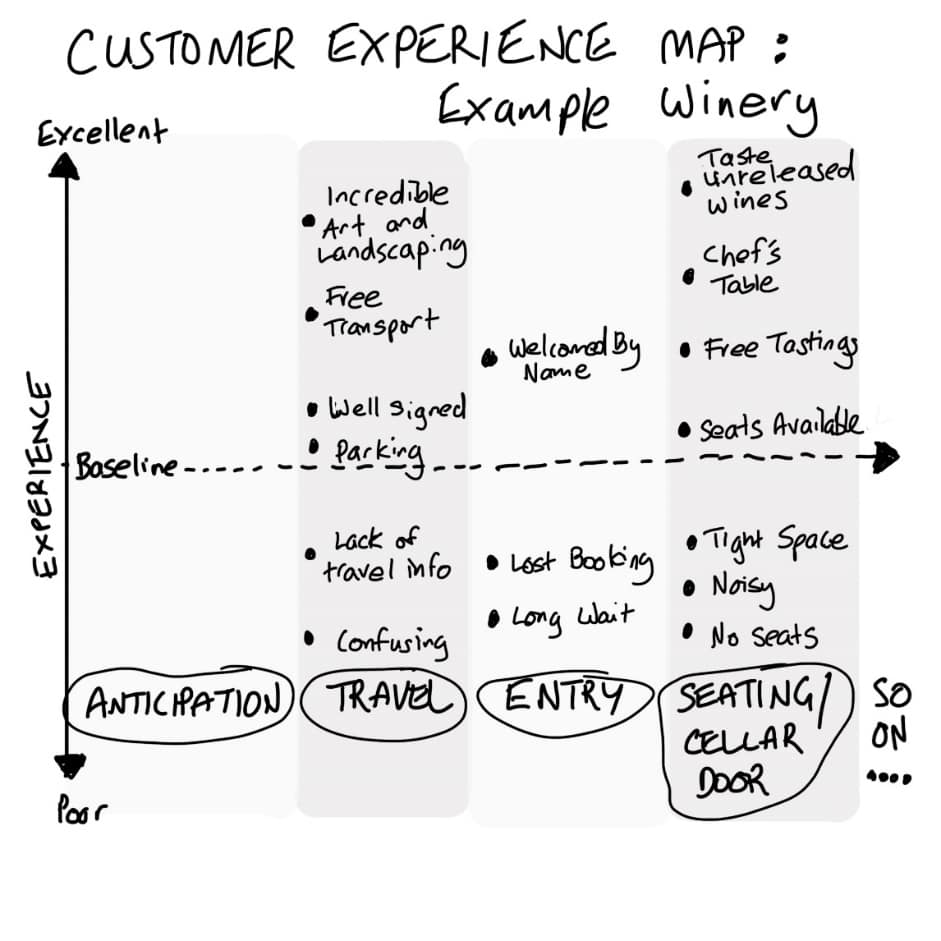
Start with a blank piece of paper and draw a graph with two axes. The horizontal axis is a timeline of the stages a customer passes through when purchasing from you. For a winery, the steps are something like anticipation, travel, entry, seating, tastings, pay, depart. For a tour or a stay, the steps are different but the idea is the same.
The vertical axis is the quality of the experience. At the bottom, write Poor. At the top, Excellent. Mark the middle point and draw a dotted line across the page. That's the baseline.
Find your baseline
A baseline experience is the typical expectation a customer has for your industry. It's well signed and not difficult to find. When you arrive, the staff greet you with a smile. These are reasonable expectations any customer might assume. At the minimum, you need to meet them. Less than this causes angst or frustration. At best, if everything else is excellent, the customer will tolerate a single step's poor experience. At worst, they'll write or speak about you negatively.
Now mark where you think your customer experience currently sits at each step. Be honest with yourself. If you fall below the benchmark, that's OK. The goal is to design the experience deliberately, not to feel good about it today.
Design for seven stars
Here's the part that matters. If you want customers to rave about your business, aim to design a seven star experience. Even if you land at five, you have a perfect rating on Google and Tripadvisor.
Brian Chesky, the co-founder of Airbnb, described the thought experiment they apply to this. At each step of the customer experience, they ask an ever increasing question. What would a seven star experience look like? What about an eight? And a nine? At some point it might not be feasible to deliver that nine or ten. But somewhere in there is a sweet spot.
A six star experience for a winery may be a chef's table in the cellar. A seven star experience may include the winemaker greeting you at the table and introducing you to unreleased wines still in barrels. Before you go through the process of asking what nine or ten looks like, seven feels inconceivable. Afterwards, it's not only conceivable. It may even appear to make sense to offer it.
Go through each step on your graph and plot what a five, seven or even nine star experience might look like. Then go back and mark where you aim.
The gap between where you are and where you want to be is the plan you need to implement. It's what you need to do to deliver an above five star experience and build a base of raving fans.
Keep drawing
Customer experience design isn't a destination. You won't design it, implement it and shelve the blueprint. Every day for the rest of your time in the business, you should be looking for more ways to surprise, delight or add value to the customer.
One sheet of paper. That's where it starts.
Adapted from Tim's book, An Absolute Must-Do, chapter 'Seven-Stars'.