Copywriting · 4 min read · 10 October 2026
The "So" Trick That Turns Features Into Reasons to Book
Have you ever seen that Simon Sinek talk about starting with your why? He uses Apple as the example. When a company is driven by a purpose, the by product is that people buy into what you do.
He puts it like this, as if he were Apple's marketing chief. Everything we do, we believe in challenging the status quo. The way we challenge the status quo is by making our products beautifully designed and simple to use. We just happen to make computers. Want to buy one?
When you sell features, you're selling the computer. Not what makes up your DNA and your brand.
I'm tipping you're currently selling on features. Here's how to flip it.
The brand pyramid
Have you heard of the brand pyramid? It's a small visualisation of the hierarchy of what makes up a brand.
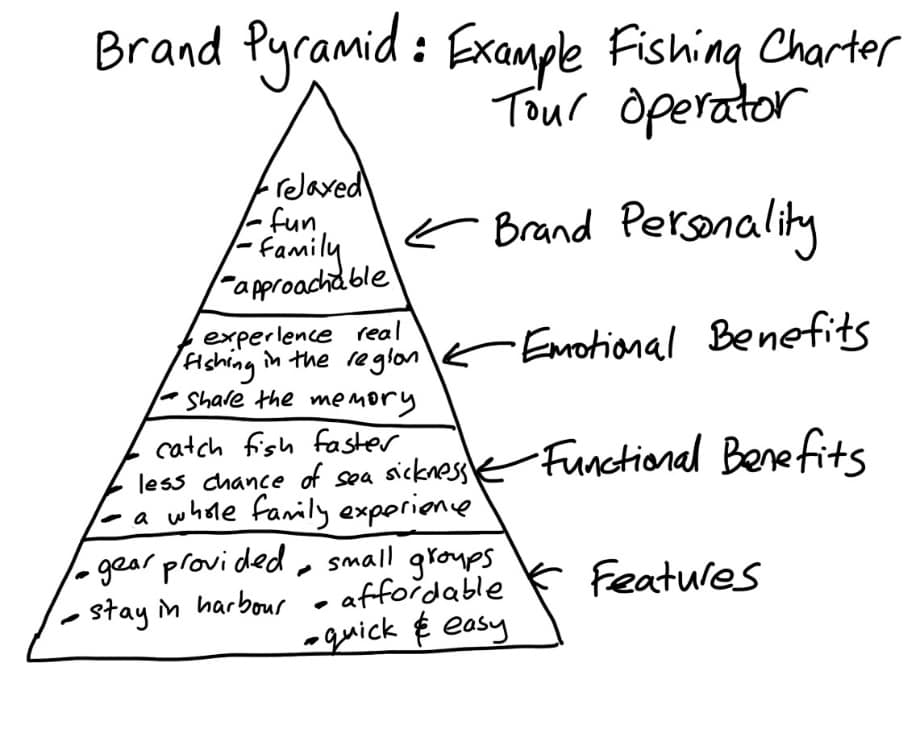
At the bottom are the features of what you sell. Above features are functional benefits, the things the customer gets from interacting with what you sell. Together they form what you are selling.
I wrote a brand strategy for a fishing charter company that doesn't leave the local harbour, unlike many competitors. A feature of their tour is that you only have a short trip out to where you start fishing, and you're always in the protection of the harbour. The benefits are that you're fishing sooner, and you're far less likely to get seasick.
Append the word so
Here's the trick. Write down each of your features, append the word "so" to the end, and finish the sentence.
Say the feature is "we provide fishing rods and bait". Finish it. We provide fishing rods and bait, so you catch more of the target species with less effort.
There's your functional benefit. Catch more fish with less effort.
Up the pyramid
Above functional benefits you have emotional benefits. How the product or experience makes the customer feel. Using the same example, that might be feeling satisfied you've had a taste of real fishing in the region without a big commitment, or creating memories that will stay with you forever.
See how these aren't attributes of the product itself. They're a level up from it.
Above those sits brand personality. Just like any human, a brand has a personality, and it leads how you and your staff interact with anything at any touchpoint. Whether you're deliberately crafting it or not, your brand has one. For the fishing charter it might be approachable, relaxed, informative, fun, maybe even cheeky. There's a big difference between how you lead an interaction if "professional" is part of your personality, as opposed to "cheeky".
At the very top is brand essence. Your why. Your DNA. For the charter, it might be that the owner has a deep personal affinity with boat fishing in the safety of the harbour as a child, and wants to share this with families so they experience the same joy.
Go and do it for your business. Features at the bottom, then "so", then how it feels, then who you are.
Then look at your website and count how many of those words you're actually using.
Adapted from Tim's book, An Absolute Must-Do, chapter 'A Tale of Two Distilleries'.